
Foundational Thinking Skills are the core thinking processes children use to make sense of the world and solve problems.
They include:
- sequencing
- pattern recognition
- symbolic reasoning
- cause-and-effect reasoning
- spatial reasoning
- problem solving
- iteration and refinement
- communication of thinking
- collaborative thinking
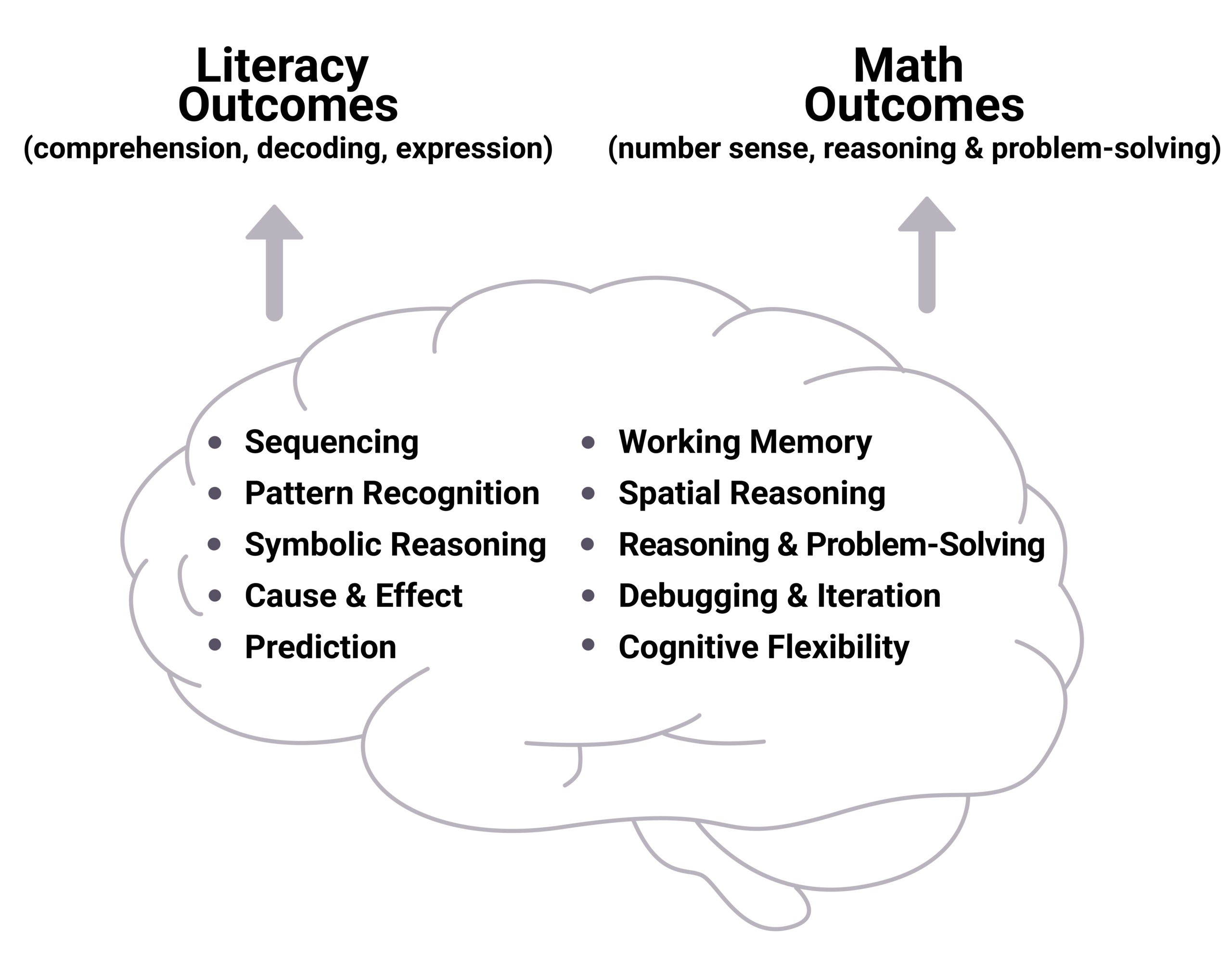
These skills are not tied to a single subject. They are the underlying structure of learning across literacy, mathematics, science, and inquiry-based disciplines.
Why They Matter
Academic skills depend on deeper cognitive abilities. To succeed in reading, mathematics, and science, children must be able to:
- follow and create sequences
- recognize patterns in symbols and language
- understand relationships between actions and outcomes
- test ideas and revise them
- explain their thinking to others
Without these abilities, learning becomes fragmented and difficult to sustain. Foundational Thinking Skills provide the structure that allows knowledge to take hold and grow.
How Children Develop These Skills
Young children develop thinking skills through hands-on exploration and active experimentation. They learn by:
- arranging and rearranging ideas
- testing what happens
- observing results
- refining their approach through repetition
- discussing their thinking with others
When thinking becomes visible and manipulable, children are able to understand it more deeply.
Making Thinking Visible
Young children develop thinking skills through hands-on exploration and active experimentation. They learn by:
- early literacy (understanding symbols and structure)
- problem-solving and persistence
- communication and collaboratio
- mathematical reasoning (patterns, sequences, relationships)
- scientific thinking (cause and effect, experimentation)
They form the bridge between early childhood exploration and later academic success.
A Foundation for Future Learning
Foundational Thinking Skills support:
- early literacy (understanding symbols and structure)
- problem-solving and persistence
- communication and collaboration
- mathematical reasoning (patterns, sequences, relationships)
- scientific thinking (cause and effect, experimentation)
They form the bridge between early childhood exploration and later academic success.
The Core Idea
Foundational Thinking Skills are the cognitive foundation for how children learn. When children can organize ideas, test possibilities, and refine their thinking, they gain the ability to learn across disciplines—and to continue learning over time.